
Anthropic just announced a feature called dreaming for Claude Managed Agents, and yes, the name sounds like someone let the marketing team near the espresso machine.
But the actual idea is useful as hell.
Dreaming lets an AI agent look back over previous sessions, spot patterns, extract lessons, and write notes/playbooks for its future self. Not model training. Not magic brain updates. Just structured memory that says: “last time we did this, here is what worked, here is what failed, don’t step on the same rake again.”
That matters because most agent failures are not one-off stupidity. They are repeatable workflow problems.
The agent forgets the customer’s house style. It keeps choosing the wrong tool. It solves 80% of the task and then fumbles the final validation. It burns context on junk. It does the same dumb little detour every single run.
Dreaming is Anthropic’s answer to that: make the agent review the receipts.
The short version
Anthropic rolled out three connected upgrades for Claude Managed Agents:
- Dreaming — agents review past sessions and memory, then create reusable lessons and playbooks
- Outcomes — you define what success looks like, and a separate grader agent checks the work against that rubric
- Multi-agent orchestration — a lead agent can split work across specialist agents with their own context windows
Put together, this is basically an improvement loop:
- Agent does the work
- Grader checks whether it actually hit the target
- Dreaming extracts lessons from the messy attempts
- Future runs start smarter
That is the interesting part. Not “AI has dreams now”. Calm down.
The real headline is: agents are moving from stateless task bots toward systems with inspectable operational memory.
Dreaming is not retraining
This distinction matters.
Dreaming does not update Claude’s model weights. The base model is not waking up with a new personality arc after a bad Monday.
Instead, the agent creates human-readable notes and playbooks. Think:
- “When reviewing medical documents, check these sections first.”
- “When landing drones in the simulation, preserve fuel until this threshold.”
- “When generating a customer report, use this structure because the team keeps approving it.”
- “When debugging this codebase, run these checks before touching implementation.”
That is less sci-fi and more useful.
Because if the memory is plain text, humans can inspect it, edit it, delete it, and argue with it. That’s a lot safer than some invisible self-improvement soup where nobody knows why the agent changed behavior.
Why builders should care
Most teams do not need a more dramatic AI demo. They need agents that stop making the same mistakes every week.
Dreaming attacks a very practical problem: institutional memory for AI workers.
Humans naturally build this. You mess up a deployment once, then next time you write a checklist. You botch a sales deck, then you remember the exec hates vague ROI slides. You spend three hours debugging a flaky test, then you write down the real fix.
Agents need the same thing.
Not because they are people. Because production work has patterns, and ignoring those patterns is expensive.
Outcomes are the underrated piece
Dreaming gets the flashy name, but outcomes might be the real workhorse.
Outcomes let developers define a success rubric. Then a separate grader agent evaluates the worker agent’s output in a fresh context window.
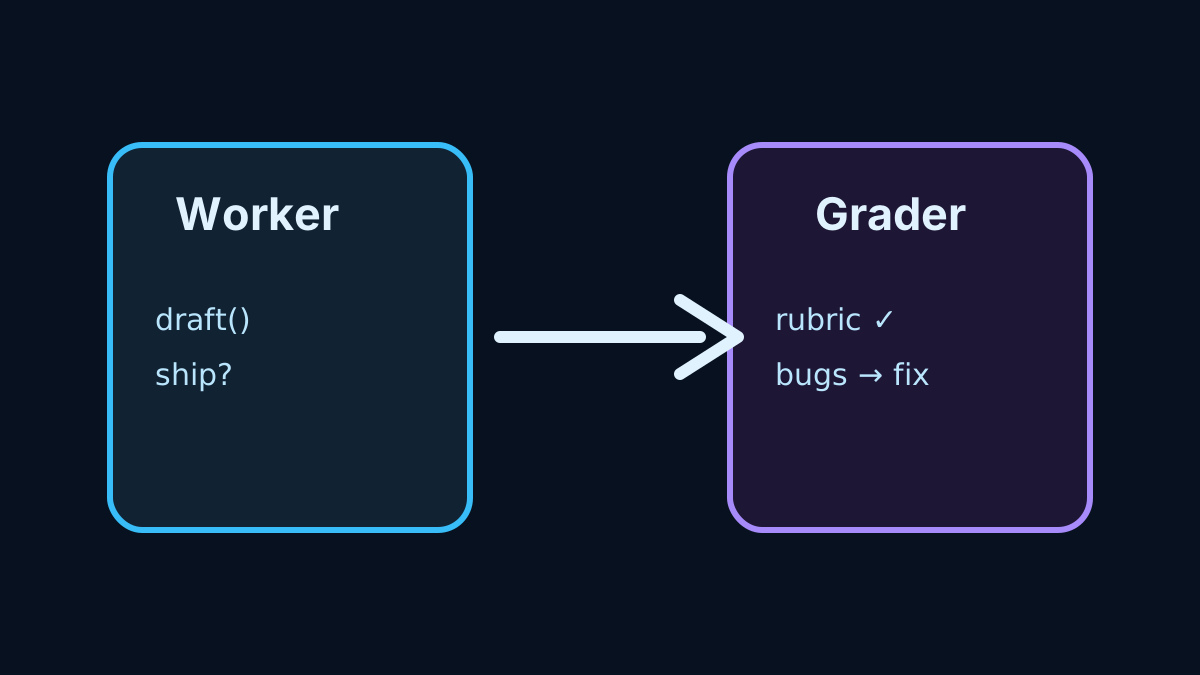
That separation is important. A long-running agent thread gets emotionally attached to its own mess. Okay, not emotionally, but practically: the same context that produced the flawed answer is not always great at judging it.
A fresh grader can say:
- This does not match the brand voice
- The answer skipped a required source
- The code passes the happy path but misses the edge case
- The summary is too vague
- The output technically works but fails the actual business goal
Then the worker gets a targeted fix list and tries again.
That is how you make agents less like interns freestyle-coding at 2 a.m. and more like a system with QA built in.
Multi-agent orchestration is context hygiene
The third upgrade is multi-agent orchestration.
A lead agent can break a large task into smaller jobs and hand them to specialist agents. Each specialist gets its own context window, tools, and instructions.
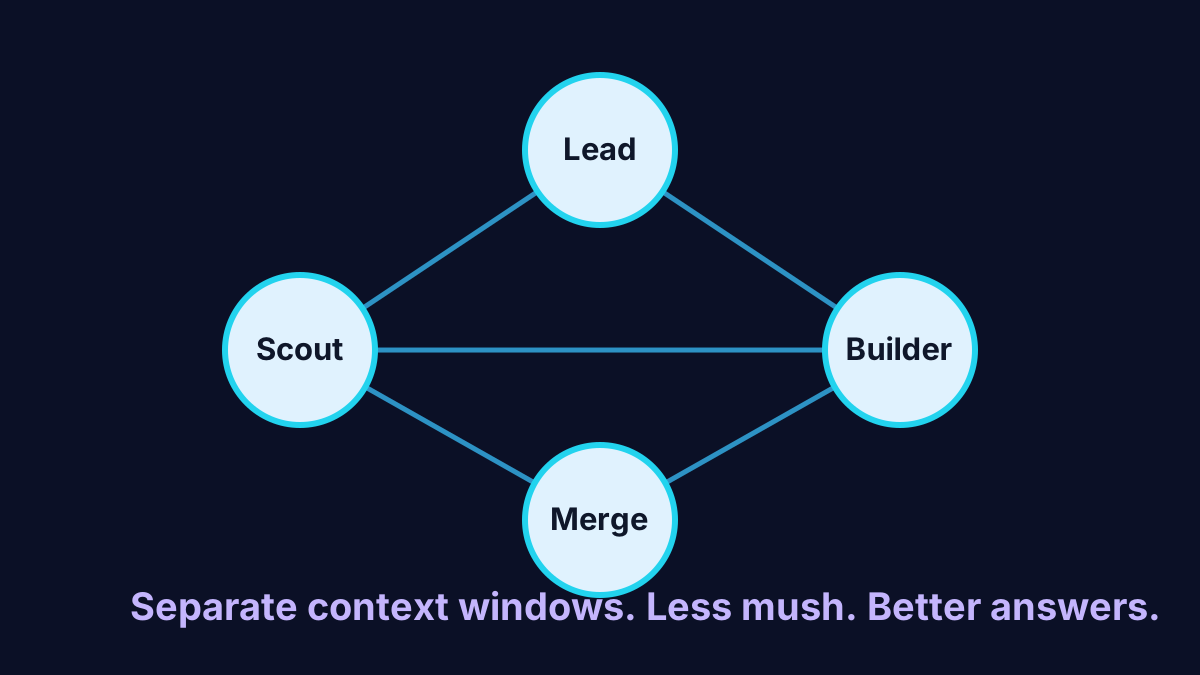
This matters because big tasks produce context sludge.
If one agent has to research, plan, code, test, summarize, and remember every failed branch along the way, its context gets noisy fast. Multi-agent setups let you spin up a specialist, let it dig through the mess, and bring back only the useful result.
That is the pattern builders should copy:
- Use disposable agents for messy investigation
- Keep the main agent focused on decisions
- Preserve only the useful artifacts
- Turn repeated lessons into playbooks
In other words: don’t make one poor model carry the entire damn warehouse on its back.
The enterprise angle
Anthropic says early customers are seeing big gains: Harvey reportedly improved task completion rates by around 6x after implementing dreaming, Wisedocs cut document review time by 50% with outcomes, and Netflix is using multi-agent orchestration to process logs from hundreds of builds.
Take the exact numbers with the usual vendor-announcement seasoning. Still, the direction is obvious.
Companies do not trust agents because agents are charming. They trust agents when the system can show:
- What happened
- Why it happened
- Whether it met the rubric
- What the agent learned
- How a human can inspect or override that learning
That is the adult version of agent hype.
The Gen Z translation
If we strip the enterprise vocabulary, Anthropic basically shipped this:
Claude agents can now watch their own game tape.
They run the play. They get graded. They review the loss. They write a better playbook. Next run, they show up less cooked.
That’s the whole thing.
And honestly? That’s the right direction.
The future of agents is not one mega-brain that magically knows everything. It is systems that:
- remember what matters
- forget what doesn’t
- check their own work with fresh eyes
- split big jobs across focused workers
- leave an audit trail humans can actually read
Less “sentient robot dream sequence.” More “competent teammate who finally writes shit down.”
GIF ideas for the post
If you want to add social embeds later, these are the right vibes:
- Charlie Day conspiracy board — for agents connecting patterns across past runs
- Michael Jordan watching game tape — for dreaming as performance review
- The Office ‘parkour’ fail energy — for agents repeating the same mistake before a playbook exists
- Chef’s kiss — for the worker/grader/outcomes loop finally landing
Bottom line
Anthropic’s dreaming feature is not scary because the AI is “dreaming.” It is interesting because it makes agent learning more boring, visible, and operational.
That is exactly what production AI needs.
Agents do not need mystical self-awareness. They need checklists, rubrics, memory hygiene, and a way to stop face-planting into the same wall every Tuesday.
Dreaming is a step toward that.
And if you’re building agent workflows right now, the takeaway is simple: make your agents leave receipts, grade the work, and turn repeated lessons into playbooks.
That is how you go from toy demo to useful system.