
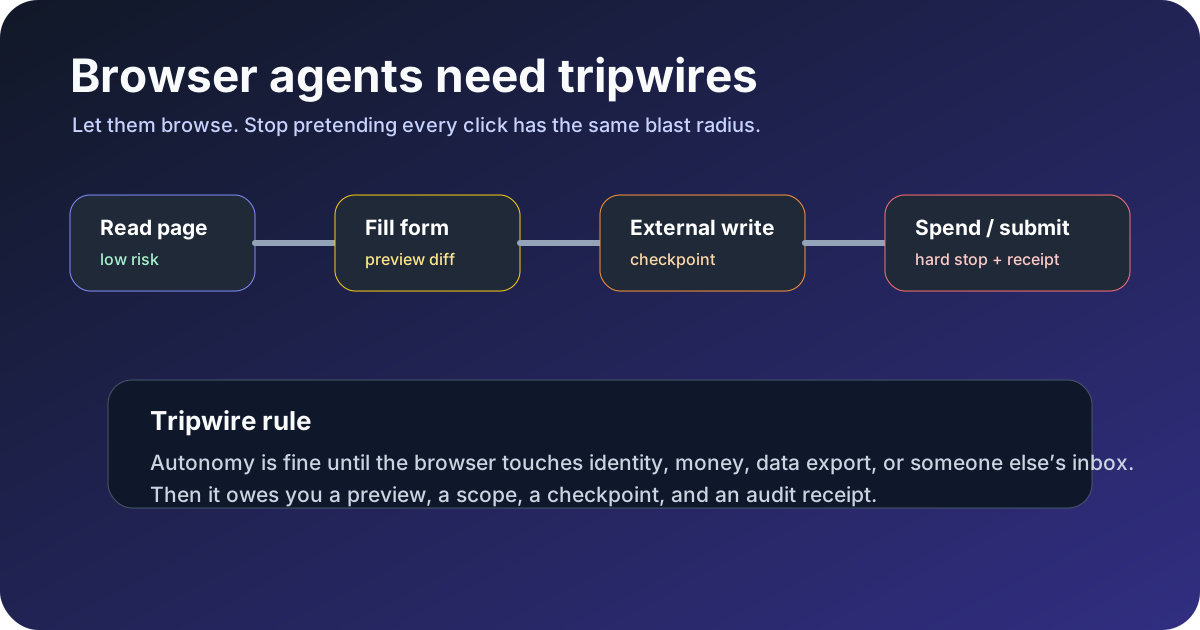
Browser agents are crossing the line from demo toy to actual work surface.
Not “summarize this page” work. Real work.
Open the site. Read the docs. Click the settings page. Fill the form. Compare prices. Pull the invoice. Draft the ticket. Submit the reply. Update the CRM. Book the damn thing.
That is useful as hell. It is also exactly where the safety story gets ugly if your control model is just “the model saw pixels, so let it cook.”
A browser is not a text box. A browser is a remote control for accounts, money, customer data, internal admin panels, production dashboards, and every weird SaaS workflow your company duct-taped together since 2017.
So browser agents need tripwires.
Not a blanket ban. Not a scary modal every three seconds. Tripwires: explicit boundaries where the session changes risk class and the agent must slow down, preview, ask, log, or stop.
Source freshness check: this post was checked on 2026-07-05 against active browser-agent and agent-tooling sources. browser-use was active on 2026-07-03, Browserbase Stagehand on 2026-07-03, Microsoft Playwright MCP on 2026-06-29, Claude Code on 2026-07-03, Gemini CLI on 2026-07-04, and Model Context Protocol on 2026-07-04. The current signal is simple: agents are getting closer to real tools, real browsers, and real accounts. Browser safety is not hypothetical polish anymore.
The browser is where prompt injection gets hands
Prompt injection used to sound abstract.
A malicious page says “ignore previous instructions.” Cute. Annoying. Sometimes dangerous.
With a browser agent, the malicious page is sitting inside the same work loop as buttons, forms, downloads, auth cookies, dashboards, and outbound messages. The web page is not just content anymore. It is part of the agent’s operating environment.
That changes the risk.
A normal user sees hostile text and rolls their eyes. An agent may treat hostile text as task context, tool instruction, customer data, UI label, or “helpful” next step. If the agent can click, type, download, upload, and submit, prompt injection stops being a model failure and starts being workflow compromise.

The mistake is treating every browser action as equivalent.
They are not.
Reading a docs page is not the same as exporting a customer list.
Clicking “next” in a public signup flow is not the same as changing SSO settings.
Drafting a support response is not the same as sending it.
Opening Stripe is not the same as refunding an invoice.
If your agent runtime cannot tell those apart, you do not have an agent platform. You have a cursor with vibes and liability.
Tripwires are risk transitions
A tripwire is a point in the workflow where the agent’s autonomy changes because the blast radius changed.
Good tripwires are boring and specific:
- first authenticated page in a session
- navigation from public web to internal app
- reading secrets, tokens, invoices, PII, or customer records
- downloading files
- uploading files
- filling a form with user or company data
- clicking submit, send, buy, delete, merge, deploy, refund, invite, revoke, or publish
- crossing domains while carrying task context
- seeing instructions from untrusted page content that conflict with the user’s task
- attempting to bypass a CAPTCHA, paywall, permission wall, or human-only checkpoint
That list is not paranoia. That is product design.
The agent can still do useful work between tripwires. Let it navigate. Let it gather evidence. Let it build a draft. Let it compare options. Let it prepare the payload.
But when it reaches a risk transition, the runtime should change mode.
Read-only mode.
Preview mode.
Human approval mode.
Receipt mode.
Hard stop mode.
The browser agent should not be deciding all of that from vibes inside the same prompt that is reading hostile HTML.
The preview is the product
If the agent is about to submit something, the user should see the exact thing being submitted.
Not “the agent wants to interact with the page.” Useless.
Show the destination. Show the fields. Show the diff. Show the account. Show the cost. Show the recipient. Show the irreversible parts. Show what the agent used as evidence.
Bad approval:
Allow browser action?
Useful approval:
Submit support reply to ticket #1842 as BuildLab? Recipient: [email protected]. No attachments. The message says X. Source evidence: dashboard status page and invoice #8812. This action sends externally and will be logged.
That is a decision a human can actually make.
A browser agent without previews is basically asking you to approve a blindfolded intern with admin access.
No thanks.

Browser sessions need compartments
The browser also needs better session hygiene.
Do not let every agent browse as the same omnipotent logged-in user. That is how you turn a convenience feature into a haunted admin puppet.
Useful browser-agent sessions should have compartments:
- separate profiles per task or trust zone
- no ambient access to unrelated accounts
- scoped cookies where possible
- blocked domains by default for sensitive workflows
- download quarantine
- upload allowlists
- network egress controls for internal data
- screenshots and DOM snapshots treated as sensitive artifacts
- expiration when the task ends
The punchline: browser automation should look more like CI than like someone casually sharing their Chrome profile.
CI learned this the hard way. Jobs get isolated runners, scoped tokens, logs, artifacts, secrets policies, environment approvals, and cleanup. Browser agents need the same energy because they are also executing work.
Different surface. Same grown-up rules.
Receipts or it did not happen
After a browser agent acts, you need a receipt.
The receipt should answer:
- what page was touched
- what user/account/session acted
- what data was read
- what fields changed
- what was submitted or downloaded
- what sources the agent relied on
- what approval, policy, or tripwire allowed it
- whether the action is reversible
- how to replay the evidence without trusting the model’s summary
This is not just compliance theater. It is debugging.
When the browser agent books the wrong flight, refunds the wrong invoice, posts the wrong comment, or exports the wrong CSV, “the model thought it was correct” is not an incident report. It is a confession that you shipped without instrumentation.
The winning browser agents will feel slower at the right moments
The best browser agents will not be the ones that click fastest.
They will be the ones that know when speed is safe and when speed is stupid.
Fast for public research.
Careful for authenticated workflows.
Preview before external writes.
Human checkpoint before irreversible actions.
Hard stop when untrusted page instructions try to steer the task.
Receipt after every meaningful mutation.
That is the shape of browser-agent reliability: not fear, not friction everywhere, but deliberate tripwires at the exact places the blast radius changes.
Because the browser is not just another tool.
It is where the agent gets hands.
And if you give a machine hands, you better give the workflow some damn guardrails.