
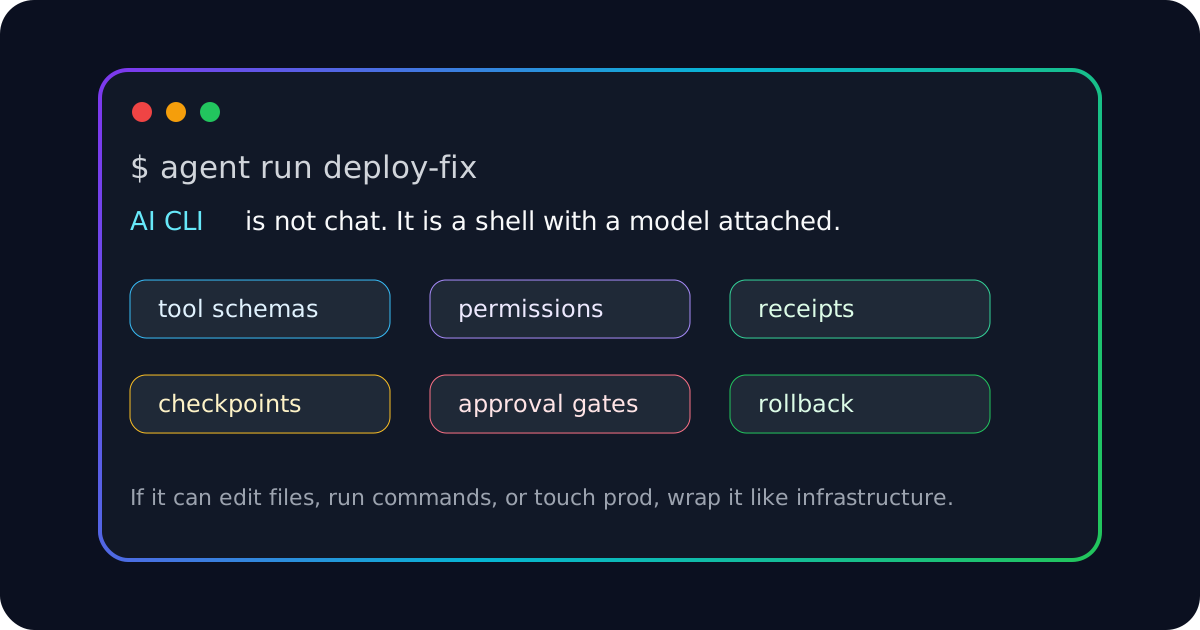
The terminal is turning into an agent cockpit.
That sounds dramatic until you look at what builders are actually doing now: handing repo context to coding agents, letting them call tools, asking them to edit files, run tests, inspect logs, wire MCP servers, and sometimes push changes while everyone pretends this is still just “chat.”
It is not chat.
An agent CLI is a shell with a model attached. Treating it like a slightly smarter autocomplete is how you end up with a very confident gremlin holding your deploy keys.
Source freshness check: this post is based on source surfaces verified on 2026-06-07. The OpenAI Codex repo, Gemini CLI repo, and Model Context Protocol repo all showed activity within the last few days. Anthropic’s Claude cookbooks showed late-May 2026 pushes and active June updates, and Microsoft AutoGen remains active in 2026. The specific product surface will keep changing; the durable point is current and boring: terminal-native agents now touch real developer workflows, so the safety model has to move from vibes to controls.
The CLI is where agents get dangerous enough to matter
Web chat is mostly bounded by copy-paste.
A CLI agent is different. It can sit inside the repo. It can see the working tree. It can run commands. It can modify files. It can inspect failures. It can chain tools. It can touch credentials indirectly through the environment if you are sloppy.
That is why CLI agents feel so damn useful.
It is also why they need grown-up boundaries.
The old mental model was:
“The AI suggests things, and a human applies them.”
The new mental model is closer to:
“The AI proposes and sometimes executes operations inside a privileged work surface.”
That is not a UX tweak. That is an infrastructure shift.

Repo context is not permission
This is the first trap.
Because the agent can read the repo, people act like it understands the authority structure of the repo.
It does not.
A model seeing package.json, CI config, deployment scripts, and production-looking environment names does not mean it knows what it is allowed to touch. Context helps the model reason. Context does not create a policy boundary.
If your agent CLI can run npm test, good.
If it can also run arbitrary shell commands, edit infra files, rewrite migrations, or push to the current branch with no checkpoint, then you do not have a coding assistant. You have a junior engineer with amnesia and root-ish vibes.
Useful? Yes.
Safe by default? Absolutely the hell not.
The minimum serious wrapper
If an agent CLI is going to operate inside real projects, the wrapper matters more than the prompt.
At minimum, serious teams need:
- tool schemas that say exactly what actions exist
- path scopes so agents cannot casually wander through the filesystem
- command allowlists for routine operations
- approval gates for external writes, secrets, deploys, and destructive actions
- checkpoints before big edits
- diff review before commit-like behavior
- receipts after every meaningful action
- rollback paths when the agent makes a mess
This is not anti-agent paranoia. This is just how you make delegated work survivable.
A human engineer can explain why they touched a file. An agent needs receipts because otherwise the explanation might be fluent nonsense stapled to a real diff.
MCP makes the shell wider
MCP is useful because it standardizes how models connect to tools and data sources.
That also means the agent CLI is no longer just “the repo plus a shell.” It can become the repo plus browser automation, GitHub, docs, databases, design files, logs, cloud resources, ticket systems, and whatever other server someone installed because the README looked cool.
That is the part people keep underestimating.
Standardized tool access does not automatically mean safe tool access.
A neat protocol can still expose a messy permission model. A beautiful schema can still point at a tool that should require human approval. A model can call the right tool at the wrong time for the wrong reason.
The pipe is not the policy.
The agent needs a flight recorder
The best CLI agents will not just do work. They will leave a useful trail.
Not a giant token dump. Not “I updated the thing” with no evidence. A real flight recorder:
- what context was loaded
- what files changed
- what commands ran
- what failed
- what was retried
- what external systems were touched
- what approvals were requested
- what changed between plan and execution
This matters because agent work is probabilistic at the reasoning layer but concrete at the filesystem layer. The output is not vibes. The output is code, commands, and state changes.
If the agent cannot show receipts, it should not get more authority.

Autonomy should be earned by boring success
The wrong question is “how autonomous can we make it?”
The right question is “which operations has it earned?”
Let the agent read freely inside a repo? Usually fine.
Let it suggest diffs? Great.
Let it apply small edits after tests? Maybe.
Let it run arbitrary commands, touch secrets, open PRs, merge, deploy, or message customers? Slow the hell down.
Autonomy should graduate by boring evidence:
- It succeeds on low-risk tasks.
- It leaves accurate receipts.
- It handles failed tools honestly.
- It respects approval boundaries.
- It passes workflow-specific evals.
- It can be rolled back without drama.
That is how agent CLIs become infrastructure instead of party tricks.
The terminal was already powerful. Now it is persuasive.
The terminal has always been dangerous. That is not new.
What is new is that the thing inside the terminal can now argue, summarize, plan, recover, and sound confident while being wrong.
That combination is why agent CLIs are going to become one of the most important developer surfaces in the next few years.
They compress tedious work. They make unfamiliar codebases less hostile. They turn debugging into a conversation with tools attached. They are genuinely useful.
But the teams that win will not be the ones who give the agent the biggest toolbox and pray.
They will be the ones who treat the agent CLI like a real shell: powerful, logged, permissioned, reviewable, and reversible.
Because once the model can act inside your repo, “just a chatbot” is not a harmless description.
It is a warning sign.