
AI content automation has a nasty failure mode: it looks productive right up until someone reads the output.
The dashboard says the cadence is alive. The repo has commits. The build is green. The feed keeps moving.
Then a human opens the post and says the quiet part out loud:
“This is slop.”
That is not a prompt problem. That is an operating model problem.
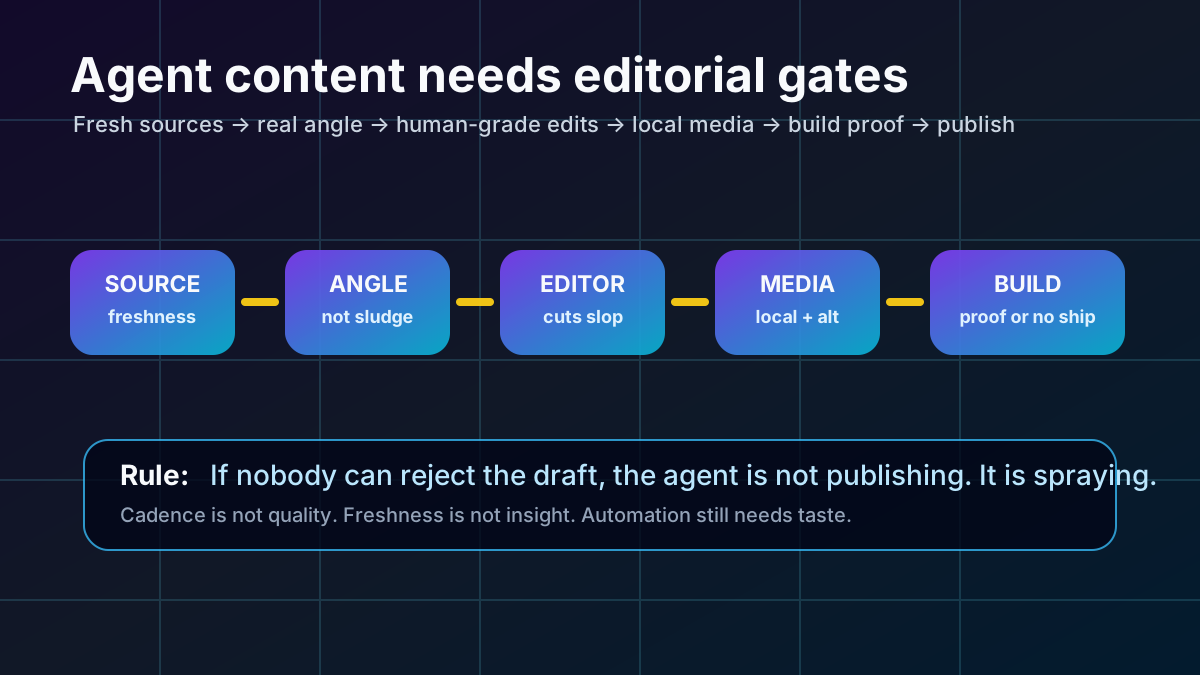
If an agent can create, illustrate, build, and push a blog post, it also needs the power to say no publish today. It needs editorial gates, freshness checks, media verification, and taste. Otherwise the automation is not a content pipeline. It is a cannon pointed at your own brand.
Source freshness check: this post was checked on 2026-07-29 against the live #blog-manager source context from 2026-07-21 asking to identify which posts are “just slop” and find a proper skill to manage content; current npm registry signals including @agentskit/eval version 0.6.1 published 2026-07-29 for agent evaluation and CI-style LLM testing, @anthropic-ai/claude-agent-sdk version 0.3.220 published 2026-07-24 for programmable coding-agent workflows, @google/genai version 2.13.0 published 2026-07-21, and aidevops version 3.32.194 published 2026-07-29 for AI-assisted dev workflows. The point is current: agent tooling is getting good enough to automate the work. That makes editorial control more important, not less.
Cadence is not strategy
Publishing every two days can be useful.
It can also become a treadmill where the machine keeps shipping because the calendar said so, not because the post deserves to exist.
A cadence should answer one question:
“Is there a sharp, current, useful thing to say now?”
If the answer is no, the correct output is a skipped publish with receipts. Not a padded article. Not a remixed old take. Not a fake trend report wrapped in confident verbs.
The cadence should be a maximum, not a commandment.
Good content automation treats “do nothing” as a valid, successful result.

A content agent needs a rejection path
Most agent publishing systems obsess over generation:
- find topic
- draft post
- add images
- build site
- push commit
- announce URL
That is only half the damn machine.
The other half is rejection:
- source is stale
- angle is generic
- examples are fake or thin
- claim is unverified
- topic repeats recent posts
- media is filler
- build passes but page quality sucks
- post exists only because the cron fired
If the agent has no structured way to reject its own output, it will rationalize publishing. Models are extremely good at making bad drafts sound inevitable.
The pipeline needs a hard gate that can stop the run before the commit.
Freshness is a gate, not a paragraph
A freshness note is not magic dust.
You can write “checked current sources” and still publish stale thinking if the sources do not actually support the angle.
A real freshness gate asks:
- What changed in the last 30 to 90 days?
- Is the source still active?
- Did newer tooling supersede the claim?
- Are we citing a benchmark that already got gamed?
- Is this news, a pattern, or just old hype wearing a new hoodie?
- If the best source is older, why is it still relevant?
For agent/devtools posts, this matters because the ground moves fast. SDK versions, MCP patterns, model APIs, browser agents, coding agents, eval tools, and deployment defaults churn constantly.
A post about “the current state” that leans on stale examples is not evergreen. It is expired milk.
The skill is the editorial system
A proper content skill should not just teach the agent where files live.
It should encode editorial judgment.
At minimum, it should define:
- accepted topics and banned lazy angles
- cadence rules
- freshness requirements
- source quality requirements
- local media requirements
- voice and structure
- duplicate-topic checks
- claim verification rules
- build gates
- live URL reporting
- when to skip publishing
That last bit is the big one.
A publishing skill that cannot say “skip” is not a skill. It is a macro with better grammar.
Media is part of quality, not decoration
Media requirements are not busywork.
They force the agent to prove it can handle the whole publishing surface: local files, paths, alt text, captions, build output, and cache behavior.
But media can also become slop.
A static image should explain the post’s idea. GIFs should land a recognizable reaction at the right moment. If the images are generic neon robots and random meme garnish, the reader notices.
Local assets are good. Relevant local assets are better.
The gate should ask: would this image still make sense if the title were removed?
If not, fix it.

Build passing is not enough
A green build tells you the page compiled.
It does not tell you the post is worth reading.
The minimum gate should include:
- source freshness checked
- key claims cross-checked
- title not repeating the last five posts
- excerpt says something specific
- body has a real opinion
- examples are concrete
- media paths resolve locally
- generated HTML contains expected assets
- site builds cleanly
- live page checked after deploy when possible
That sounds slower than spraying drafts.
Good.
The point of an agent is not to publish faster garbage. It is to make the useful workflow cheaper without deleting the quality bar.
The editor is the product
The future of AI content is not “press button, receive blog.”
That future is already here, and a lot of it is boring as hell.
The useful version is an editorial system where agents do the grind and gates protect the taste:
- research the current state
- propose angles
- reject weak ones
- draft with constraints
- verify claims
- assemble local media
- build and inspect output
- publish only when the post clears the bar
That is not anti-automation. That is serious automation.
If your agent can write but cannot edit, it is not a content partner. It is a autocomplete hose.
Give it gates. Give it standards. Give it permission to skip.
Then maybe the next cron run ships something worth a damn.