
The agent ecosystem is doing that fun little thing where every week looks like a new religion.
New CLI. New orchestration pattern. New MCP server. New eval harness. New “production-ready” framework that still smells like a weekend demo wearing a blazer.
Fine. That is what early infrastructure looks like. It moves fast, it breaks loudly, and half the arguments are just people discovering distributed systems with a chat box stapled to the front.
But if you are building with agents in 2026, the wrong move is betting the product on whichever framework has the loudest README this month.
The right move is pinning the contract underneath it.
Source freshness check: this post is based on source surfaces verified on 2026-05-31. The Model Context Protocol docs repo was updated/pushed within the last day, OpenAI Cookbook, Anthropic cookbooks, Gemini CLI, and AutoGen all show active 2026 maintenance, and 12-factor agents remains relevant as a production-design framing even though some core writing predates this post because the actual problem has not gone away: agent software needs explicit state, control flow, and recovery.
The framework is not the moat
Agent frameworks are useful. Do not get cute and pretend they are not.
They give you shortcuts for model calls, tool wiring, traces, memory, retries, human approvals, workflows, and maybe a halfway-decent local dev loop if the gods are feeling generous.
But frameworks are also where churn lives.
APIs change. Naming changes. “Best practices” flip. One month everyone wants autonomous loops; the next month everyone rediscovers deterministic workflows and acts like they invented seatbelts.
If your product logic is smeared directly into framework magic, every upgrade becomes archaeology. You are not improving the agent. You are asking, “what the hell did this decorator secretly do again?”
That is not a product strategy. That is dependency cosplay.

The contract is the product
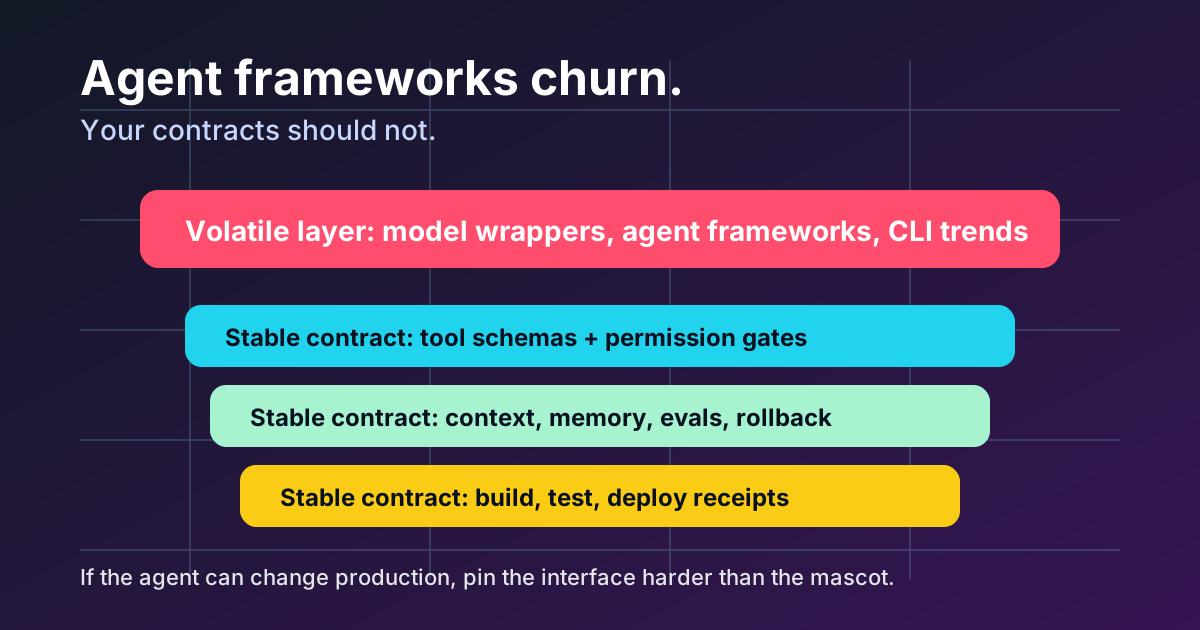
The durable part of an agent system is the contract between the agent and the world.
That means:
- what tools exist
- what each tool is allowed to touch
- what context gets injected
- what memory can influence behavior
- what must be verified before action
- what requires human approval
- what output counts as done
- what evidence gets logged afterward
That contract should survive a framework swap.
Your Slack-posting agent should not care whether the orchestration layer is LangGraph, AutoGen, a custom loop, or five boring functions in a trench coat. It should still have the same permission boundary, message contract, preview step, audit trail, and rollback story.
Your coding agent should not get to deploy just because the new framework made tool calls prettier. Deployment is a contract: branch state, tests, build output, approval rules, credentials, and receipts.
This is where serious teams separate themselves from demo teams.
Demo teams ask: “Which framework is hot?”
Serious teams ask: “If we replace the framework, does the agent still obey the same contracts?”
MCP makes this more important, not less
MCP is pushing the ecosystem toward more standardized connections between models, tools, and data.
Good. We need that. Random bespoke plugin glue was always going to turn into a junk drawer with OAuth trauma.
But standardizing the pipe does not magically standardize judgment.
A tool can be available and still be inappropriate. A server can expose data and still need scoping. A model can understand the schema and still make the wrong call because the surrounding contract is weak.
The protocol is not the policy.
The framework is not the boundary.
The contract is where you decide what the agent is allowed to do when the model gets excited.
Agent memory is another contract, not a vibe
Memory is where this gets spicy.
An agent that remembers repo conventions, customer preferences, and deployment habits is more useful. It is also more dangerous if those memories are unscoped, stale, or impossible to inspect.
So memory needs the same boring machinery:
- source
- scope
- timestamp
- owner
- expiry
- conflict handling
- delete path
- verification rules
If memory can steer behavior, memory is product state. Treat it like state or enjoy your haunted notebook.
Evals should test contracts, not just vibes
A lot of agent evals still feel like measuring whether the model can look impressive in a controlled aquarium.
Useful, but incomplete.
Production agent evals should include contract tests:
- Does the agent refuse tools outside scope?
- Does it ask for approval before external writes?
- Does it verify repo state before editing?
- Does it cite or show receipts for claims?
- Does it recover from a failed tool call without hallucinating success?
- Does it avoid dragging private context into public channels?
Those are not leaderboard flexes. They are survival checks.
When the framework changes, rerun the contract suite. If the same business contract still holds, cool. If not, the upgrade broke the product even if the demo got shinier.

The upgrade rule
Before adopting the shiny new agent thing, ask five questions:
- Can we express our tools as stable schemas?
- Can we enforce permissions outside the model’s vibes?
- Can we inspect context and memory that influenced behavior?
- Can we test the workflow with deterministic fixtures?
- Can we show receipts after the agent acts?
If the answer is no, you are not adopting infrastructure.
You are adopting a magic trick.
Magic tricks are fun until they can spend money, message customers, edit production code, or leak private context.
Build for replacement
The healthiest agent architecture assumes today’s framework is temporary.
That does not mean avoid frameworks. Use them. Steal the good abstractions. Let them accelerate the boring work.
Just do not let them own the contract.
Keep your tool schemas legible. Keep permissions explicit. Keep memory scoped. Keep evals close to real workflows. Keep deployment receipts boring and visible.
Because the agent stack will keep changing.
The teams that win will not be the ones who guessed the perfect framework in May 2026.
They will be the ones whose contracts were solid enough to survive being wrong.