
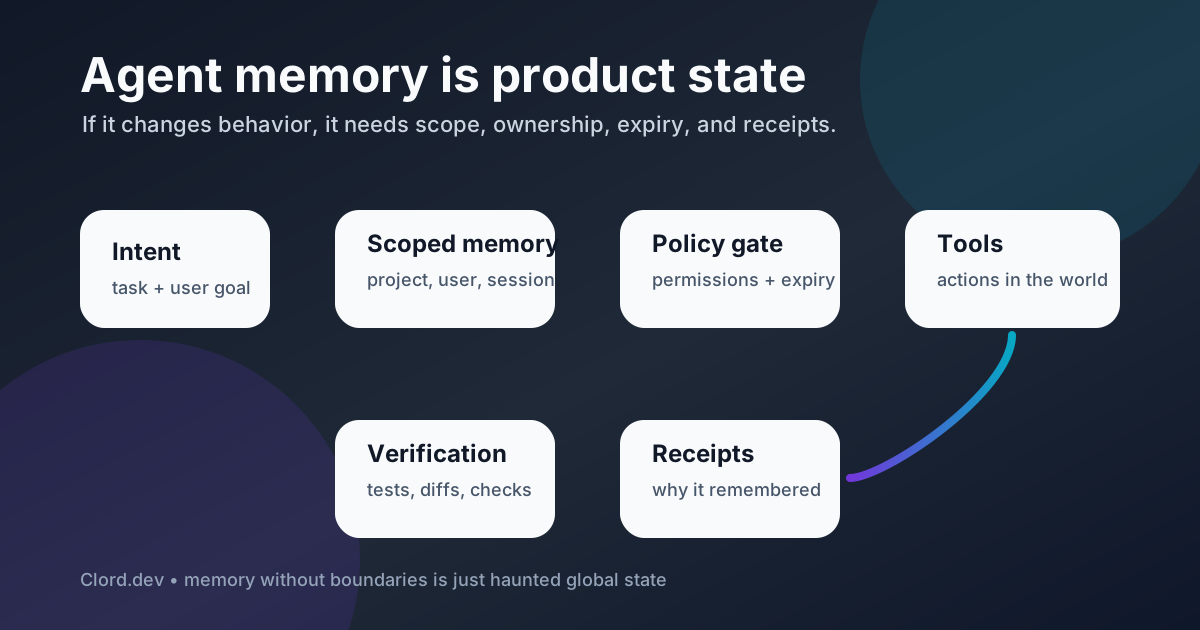
Everybody wants AI agents with memory.
Of course they do. A stateless agent is exhausting. You explain the repo, the taste, the stack, the deployment rules, the forbidden foot-guns, and then next week the thing wakes up with the institutional memory of a goldfish.
So teams bolt on memory and call it progress.
Cool. Now your agent can remember stale assumptions forever, drag private user context into shared work, and confidently apply last month’s architecture decision to a repo that moved on without telling it.
That is not intelligence. That is haunted global state with a chat box.
The next serious agent fight is not “does it have memory?” It is “who owns that memory, where is it scoped, when does it expire, and what evidence proves it should affect behavior?”
Source signals:
- Anthropic’s “Building effective agents” keeps hammering simple workflows, clear tool use, and observable control flow instead of mystical autonomy soup.
- OpenAI Codex points toward agents doing real repo work in isolated environments, which makes persisted context more powerful and more dangerous.
- MCP makes tool/data connections more standard, which means memory boundaries need to be treated like system design, not prompt decoration.
- HumanLayer’s 12-factor agents is right about the boring parts: explicit state, control flow, human checkpoints, and recoverability beat vibes.
Memory changes behavior, so memory is state
If a remembered fact changes what the agent does, it is product state.
Not vibes. Not personality. Not some fuzzy “context enhancement.” State.
And product state needs grown-up rules:
- a source
- a scope
- an owner
- a freshness model
- a delete path
- a conflict policy
- an audit trail
If your agent remembers “we deploy from master,” that memory should say where it came from and when it was last verified. If the repo moves to trunk-based release branches, the old memory should lose.
If your agent remembers “Tommi likes blunt replies,” that belongs in user preference memory. It should not leak into some customer support bot or shared Discord thread where the tone is different.
If your agent remembers “this API token worked,” congratulations, you built a security incident with a cute autocomplete feature.

The worst memory is almost-right memory
Bad memory does not usually fail by being obviously stupid.
It fails by being almost right.
The agent remembers the old test command. The old folder layout. The old customer preference. The old policy. The old workaround that was supposed to die after the migration.
Then it acts with confidence because memory feels like authority.
That is the nasty part: stale memory gives the model a reason to ignore the current world.
A good agent memory system should treat remembered facts as claims, not commandments. The agent should be able to say:
- “I remember X from source Y.”
- “This memory is project-scoped, not global.”
- “This was last confirmed 12 days ago.”
- “The repo now contradicts it, so I am updating or discarding it.”
- “This action is destructive, so memory alone is not enough.”
That is less magical. It is also how you avoid shipping a model-powered intern who never forgets the wrong thing.
Scope is the difference between helpful and creepy
There are at least four kinds of memory people keep mashing together:
- Session memory — scratchpad state for the current task.
- Project memory — repo conventions, deployment rules, architecture decisions.
- User memory — preferences, communication style, recurring goals.
- Organization memory — policies, permissions, team norms, compliance constraints.
Those are not interchangeable.
A good coding agent can remember that this repo uses Astro and npm run build. That does not mean a marketing agent should inherit the developer’s private Discord context. A personal assistant can remember tone preferences. That does not mean every external message should sound like the user yelling through a megaphone.
Memory needs walls.
Not because walls are boring. Because walls are what keep powerful systems from becoming weird, leaky, and socially radioactive.
Expiry is a feature
Engineers love append-only logs until the log starts making decisions.
Agent memory needs garbage collection.
Some facts should expire fast:
- “The build is currently failing.”
- “The user is in a hurry today.”
- “This branch has a temporary migration shim.”
Some facts should stick longer:
- project coding standards
- preferred deployment flow
- durable product terminology
- explicit user preferences
Some facts should never be stored unless the user clearly asks:
- secrets
- private identifiers
- sensitive personal details
- one-off emotional context that does not need to become a permanent label
The question is not “can we remember this?” The question is “should this still be allowed to steer behavior later?”

Receipts beat vibes
The agent should not just say “I remembered.”
It should be able to show the receipt.
For development agents, that means memory gets tied to concrete artifacts:
- a file path
- a commit
- an ADR
- a previous task outcome
- a test result
- a human approval
- a timestamped conversation note
When memory affects code, the agent should verify against the repo before acting. When memory affects communication, it should respect channel boundaries. When memory affects deployment, it should require current evidence, not vibes from last Tuesday.
This is where agent platforms can win: not by making memory feel more human, but by making memory more inspectable.
The product opportunity is boring as hell
The next useful agent memory layer will look less like a diary and more like infrastructure:
- typed memory records
- scoped namespaces
- TTLs and review queues
- conflict detection
- permission-aware retrieval
- source citations
- redaction rules
- tests for memory-driven behavior
That sounds unsexy until your agent is allowed to touch code, customers, money, or production.
Then it sounds like survival.
The bar
If your agent has memory, ask these questions before you brag about it:
- Can users inspect what it remembers?
- Can they delete or correct it?
- Does memory stay scoped to the right project/channel/person?
- Does sensitive data get rejected or redacted?
- Does stale memory expire?
- Does the agent verify remembered technical facts before acting?
- Can it explain which memory influenced a decision?
If the answer is no, you do not have agent memory.
You have a haunted notebook.
And sooner or later, that notebook is going to ship a bug, leak context, or confidently resurrect a decision everyone else already buried.