
Agent tooling is drifting toward a familiar shape: registries.
Not always official registries with polished branding. Sometimes it is a GitHub list. Sometimes it is an MCP directory. Sometimes it is a marketplace tab. Sometimes it is a Discord link to a server that “just works.” Sometimes it is a single-file agent someone tells you to drop into your workflow because it saved them ten minutes.
Cool.
Also: that is exactly how software supply chains become a haunted vending machine.
When an agent installs a tool, it is not just installing code. It may be installing instructions, permissions, auth flows, prompts, network behavior, filesystem access, browser access, and the ability to ask a model to do things with your data.
So agent registries need quarantine.
Not vibes. Not stars. Not “the README looks friendly.” Quarantine.
Source freshness check: this post was checked on 2026-07-07 against live GitHub API results for MCP security scanners, MCP server security projects, agent registries, and browser-driven agent orchestration. Current examples included harikrishn4101/MCPScan, described as scanning MCP servers for security issues and updated 2026-07-07; dockfixlabs/agentguard, described as an AI agent code security scanner and updated 2026-07-07; kody-w/RAR, described as an open single-file AI agent registry and updated 2026-07-07; and JavaZeroo/code-orchestrator, described as browser-driven multi-agent development orchestration and updated 2026-07-07. The exact repo names will churn. The signal will not: agent tooling is becoming installable infrastructure, and installable infrastructure needs supply-chain discipline.
The registry is a trust boundary
Developers learned this lesson with package managers, browser extensions, CI actions, container images, Terraform modules, and random curl-pipe-bash scripts.
The thing you install becomes part of the system.
Agent tools make that worse because they often sit beside natural-language authority. A normal dependency can execute code. An agent dependency can execute code, shape the model’s instructions, request tool calls, define schemas, steer context, and quietly become part of the decision loop.
That is not a plugin. That is a trust boundary wearing a cute name tag.

If a registry entry can add tools, read files, call APIs, browse pages, send messages, write code, or influence prompts, then the registry is part of your production control plane.
Treat it that way.
Stars are not security
A registry page usually gives you social proof first:
- stars
- downloads
- last updated
- author name
- screenshots
- “works with Claude/Cursor/Codex/Gemini” badges
- a friendly demo GIF
Useful signal? Sometimes.
Security model? Hell no.
Stars do not tell you whether the package exfiltrates context. Downloads do not tell you whether the tool asks for broader scopes than it needs. A recent commit does not tell you whether the release artifact matches the source. A slick README does not tell you whether the server phones home when the agent hands it secrets.
Agent registries need machine-checkable trust signals:
- signed releases
- reproducible or at least traceable builds
- declared permissions
- declared network egress
- declared filesystem scope
- tool schemas that can be inspected before install
- prompts and system instructions surfaced as reviewable artifacts
- dependency scans
- known-bad package detection
- owner history and takeover warnings
- version diff summaries before upgrade
The boring metadata is the product.
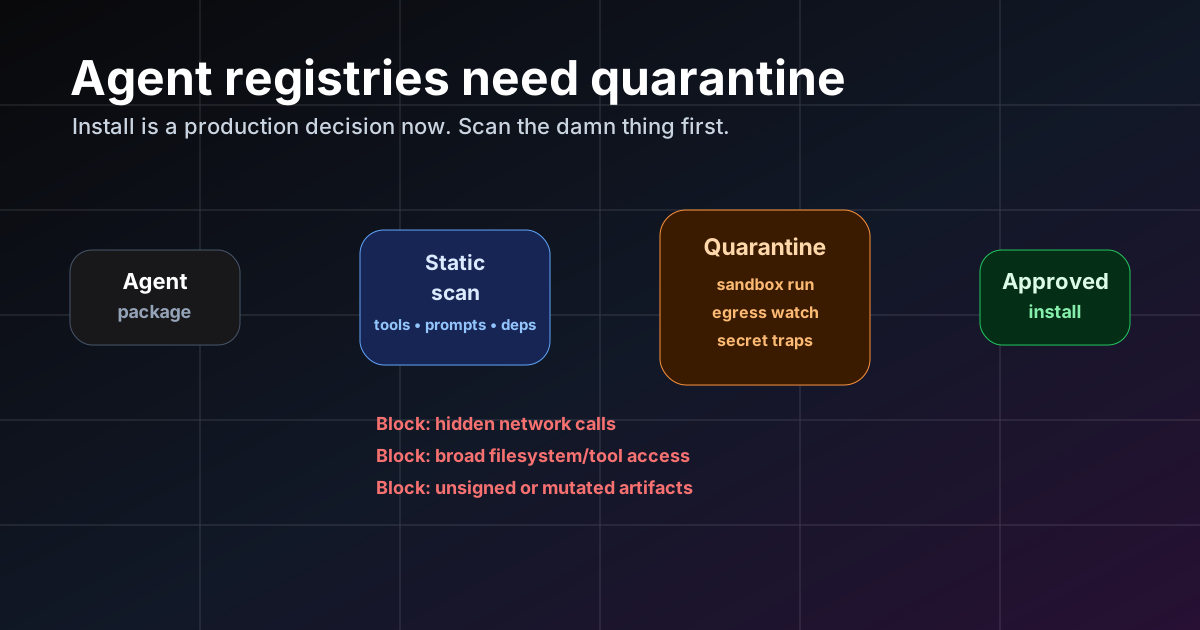
Quarantine before install
The right install flow should feel more like a security checkpoint than a slot machine.
A healthy registry can still be fast. It just needs stages.
First: static scan.
Read the manifest. Parse the tool schema. Inspect requested permissions. Check dependencies. Look for suspicious install scripts. Flag prompt instructions that try to override user policy, hide behavior, harvest secrets, or claim broad authority.
Second: sandbox run.
Start the server in a locked environment. No ambient credentials. No production files. Fake secrets planted as canaries. Egress watched. Tool calls logged. Prompts captured. Unexpected writes blocked.
Third: provenance check.
Who published this? Did the owner change? Did the package suddenly add network access? Does the release match the repo? Are there known vulnerable dependencies? Did the tool quietly expand from “read docs” to “read your home directory and send HTTP requests anywhere”?
Fourth: human-readable receipt.
Before install, show the user what changed and what risk class they are accepting.
Not “Install agent helper?”
Try this:
Install
example-mcp-serverversion 1.8.2? Requests: local filesystem read under/projects, outbound HTTPS to two domains, tool calls that can modify Git branches. New since 1.7.0: added shell command execution. Sandbox observed no unexpected egress. Publisher unchanged. Approval expires in 30 days.
That is a real decision.
MCP makes this urgent
MCP is useful because it gives agents a common way to connect to tools.
That is also why MCP makes registry hygiene urgent.
A standard connector shape means tools spread faster. Faster spread means more copy-paste installs, more unofficial directories, more “try this server,” more abandoned packages, more impersonation, more dependency confusion, and more pressure to trust something because everyone else is using it.
That is the npm story. The browser-extension story. The CI-action story. The container story.
Agent people should not need to touch the stove again to learn that hot things burn.

The fix is not “never install community tools.” That is lazy.
The fix is a trust pipeline where community tools can earn permissions gradually.
Read-only first. Local sandbox first. No secrets by default. Explicit egress. Scoped filesystem. Expiring approvals. Receipts for upgrades. Fast revocation when a tool gets weird.
The registry should enforce least privilege
Agent tools should not get a giant bag of power because the install button was clicked once.
A registry should make least privilege the default posture:
- tool declares what it wants
- runtime grants the minimum
- user can see and edit scopes
- high-risk scopes require extra approval
- scopes expire
- upgrades cannot silently expand scopes
- unused permissions get revoked
- risky tool categories get stronger defaults
A calculator tool does not need network access.
A docs search tool does not need write access.
A Git helper does not need your browser cookies.
A browser automation skill does not need production deploy credentials.
If that sounds obvious, good. Now build the registry so obvious things are enforced by software instead of remembered by tired humans at 1 a.m.
The winners will make trust portable
The best agent registries will not just list tools. They will carry trust state with the tool.
What was scanned. What was observed. Who approved it. What version was approved. What scopes were granted. What changed. What broke. What got revoked. What orgs are using it safely. What incidents are attached to it.
That trust state should travel from local dev to CI to production. Same tool, different risk class, different permissions, same receipts.
Because agents are no longer just text generators glued to a terminal.
They are becoming installable work systems.
And installable work systems need the same old-school discipline every other ecosystem learned the painful way: quarantine first, trust later, receipts always.
Anything else is just letting the vending machine install hands into your company.