
Agents are not just chat windows anymore.
They are runtimes.
A serious agent session now has tools, memory, shell access, browser state, MCP servers, repo checkout state, credentials, queues, traces, approval prompts, and some half-lit hope that the model will not do anything cursed before coffee.
That hope is not architecture.
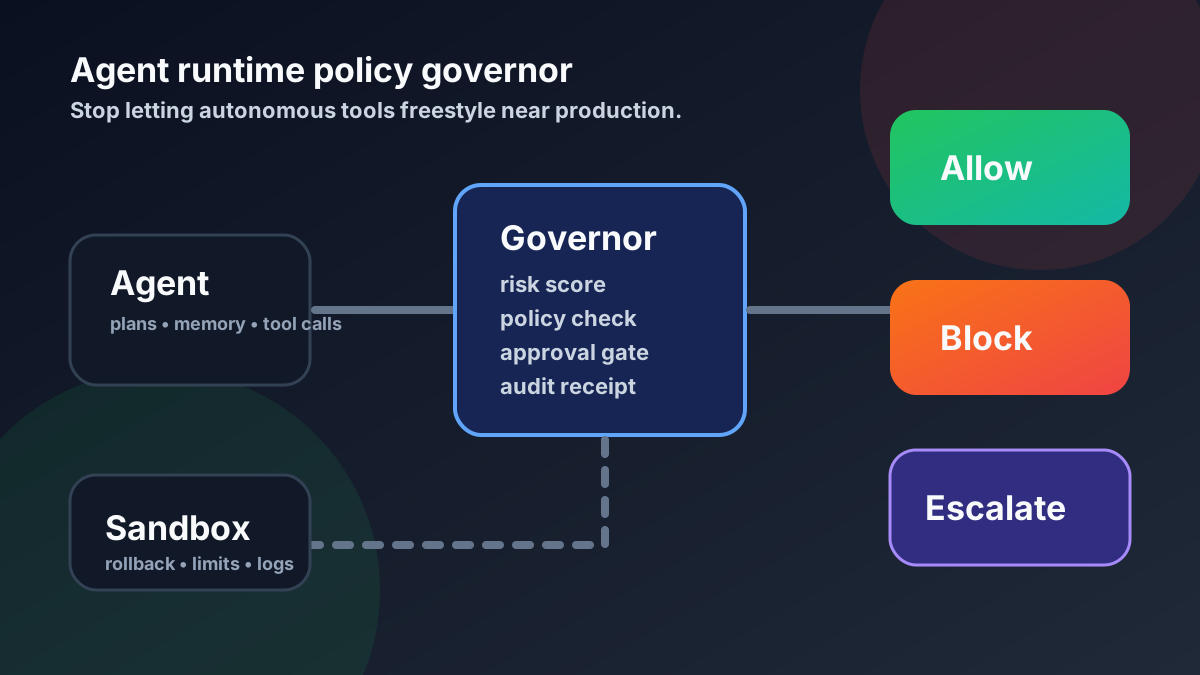
The missing piece is a policy governor: a runtime layer that can decide, before a tool call lands, whether the action should be allowed, blocked, challenged, escalated to a human, sandboxed, rate-limited, or rolled back.
Source freshness check: this post was checked on 2026-07-12 against live GitHub API results for agent runtime security, MCP scanners, observability, and sandbox tooling pushed during 2026-07-12. Current examples included Skylar-Jiang/aegis-agent-runtime, described as a risk-adaptive runtime security architecture for tool-augmented AI agents with policy-aware execution, sandboxing, commit/rollback, permission gating, memory protection, and audit tracing; Etherisys/etherfence, described as local-first AI agent security posture and runtime control with MCP risk discovery and least-privilege policy enforcement; yatuk/mcpradar, described as an MCP security scanner catching tool poisoning, prompt injection, and supply-chain attacks; 0xSteph/patient-zero, described as a supply-chain scanner for npm, Python, and MCP agent configs; and tools-for-agents/anvil, described as a throwaway Docker sandbox for agents with isolated, resource-limited command execution and structured results. The specific repos will churn. The live signal is current: builders are wrapping agents with runtime control planes because autonomous tool use without policy is a loaded nail gun.
The agent runtime is where incidents happen
Most agent safety talk gets stuck in model land.
Prompt harder. Align better. Add a system instruction. Tell the model to be careful. Put “do not delete production” in bold.
Cute.
The incident does not happen in the prompt. The incident happens when the tool executes.
The shell command runs. The browser clicks. The MCP server returns poisoned instructions. The agent reads stale memory. The credential broker hands over too much. The dependency installer fires postinstall. The deploy tool ships a broken branch because the diff looked plausible.
That means the control point cannot just be text.
It has to be runtime policy.

A proper agent runtime asks questions before impact:
- what tool is being called?
- what resource is in scope?
- is this read-only or write-heavy?
- does it touch secrets, money, users, production, or external messages?
- did the plan mention this action?
- has a similar action failed recently?
- does the sandbox have rollback state?
- did a human approve this exact capability or just vaguely click yes?
- should the model even see the raw output?
If your runtime cannot answer those questions, the model is driving with cardboard brakes.
Policy is not a permission checkbox
A permission checkbox says “this agent may use shell.”
A policy governor says “this agent may run this command class, against this repo, inside this sandbox, with these network rules, for this duration, after this approval, while producing this audit receipt, and rollback is mandatory if verification fails.”
That sounds annoying because it is the grown-up version.
But production is annoying. That is why it works.
The runtime needs a small set of boring verbs:
- allow safe low-impact actions
- block obviously dangerous actions
- challenge suspicious actions with extra verification
- escalate high-impact actions to a human
- sandbox uncertain actions until validated
- revoke capabilities when behavior drifts
- rollback changes when post-checks fail
- record the exact reason and evidence
The important part is that the decision happens before execution, not after the agent has already redecorated prod with a flamethrower.
MCP made this urgent
MCP is useful because it gives agents a common way to reach tools.
MCP is dangerous for the exact same reason.
A single agent can suddenly see databases, ticket systems, browsers, clouds, file systems, deployment commands, and custom internal APIs through one growing tool surface. That is powerful as hell. It is also supply-chain-shaped.
A runtime governor should treat every tool server like an untrusted dependency until proven otherwise.
That means scanning configs, pinning versions, limiting tool scopes, inspecting descriptions for prompt injection bait, blocking surprise network access, and refusing tool calls that do not match the active task.

The correct posture is not “install MCP server, pray.”
The correct posture is “quarantine it, score it, constrain it, observe it, and only then let the agent near it.”
Memory needs policy too
Runtime policy is not just about tools.
Memory is authority.
If an agent remembers stale architecture, fake preferences, old credentials, discarded product decisions, or poisoned instructions from a previous task, it can make confident garbage look like continuity.
So the governor needs memory rules:
- what memory class can this task read?
- is the memory fresh enough?
- who wrote it?
- was it verified?
- can it override the current user instruction?
- should it be summarized instead of injected raw?
- does it contain sensitive material that belongs outside model context?
Memory without provenance is just a haunted notebook.
The runtime should produce receipts
When the agent does something important, the runtime should leave evidence a reviewer can understand later.
Not a giant token swamp. Not vibes. Receipts.
For every meaningful action, capture:
- requested action
- policy decision
- risk factors
- approval identity, if any
- sandbox/container/session id
- inputs and redacted outputs
- verification result
- rollback status
- final artifact or commit
This is how agent systems become operable. Not because the model becomes perfect, but because the runtime makes behavior inspectable, reversible, and boring enough to trust.
Build the damn governor
The agent stack is moving toward one obvious shape:
model → planner → runtime governor → tools → verification → receipt.
Skip the governor and every other layer gets worse. Approvals become button mashing. Sandboxes become optional theater. Observability becomes archaeology. Security becomes a Slack apology template.
The model can propose.
The runtime decides what is allowed to become real.
That is the line.
If your agent can touch production systems, customer data, money, deployments, or public channels, it needs a policy governor now — not after the first incident writes the roadmap for you.