
Coding agents are getting good enough that the dangerous part is no longer whether they can write a patch.
The dangerous part is where that patch gets written.
If your agent is sitting inside a real working tree, on a real developer machine, with real credentials nearby, and a shell that can wander around like it pays rent, you do not have an “AI assistant.” You have a probabilistic coworker operating in a production-shaped room with no badge reader.
That is a dumb way to get impressive demos and weird incidents.
Agent sandboxes are the new CI. Not because CI is sexy. Because CI is the boring boundary that stopped every random local machine from becoming the source of truth.
Source freshness check: this post was checked on 2026-06-09. The OpenAI Codex repository showed activity on 2026-06-09 and describes a lightweight coding agent that runs in the terminal. The Gemini CLI repository also showed 2026-06-09 activity and positions itself as an open-source AI agent for the terminal. The Model Context Protocol repository showed 2026-06-08 activity, and Anthropic’s cookbook repository remains active around late May and early June 2026. The exact tools will churn. The durable current-state fact is boring as hell: agentic devtools are actively being built around terminal, repo, and tool access, so isolation has moved from nice-to-have to baseline.
Local machines are bad agent habitats
Developer laptops are messy.
They have half-finished branches, stale build artifacts, personal config, cached tokens, private SSH keys, random aliases, broken package managers, and that one .env.local file everyone swears is harmless until it is not.
Humans can mostly navigate that mess because they made it.
Agents cannot.
They can infer. They can inspect. They can ask. They can run commands. But they do not actually know which weird bit of local state is intentional, which credential is sensitive, which generated file is safe to delete, or which command turns a test run into a cloud bill.
So when teams point a coding agent at a local repo and say “fix this,” they are quietly accepting a huge amount of environmental ambiguity.

The sandbox is the contract
A real agent sandbox should answer the questions a prompt cannot enforce reliably:
- What files can the agent read?
- What files can it write?
- Which commands can it run without approval?
- Is the network available?
- Are secrets mounted at all?
- Can it call external tools?
- Can it open a PR, push a branch, deploy, or message someone?
- What gets captured as evidence?
- How do we reset the world when it screws up?
That list is not bureaucracy. It is the difference between delegated work and uncontrolled side effects.
A good sandbox gives the agent enough room to be useful and enough walls to keep mistakes boring.
That is the sweet spot.
CI taught us this already
We already learned this lesson with software builds.
Nobody serious says, “The app passed on Dave’s laptop, ship it.”
We run clean builds. We pin dependencies. We isolate jobs. We capture logs. We fail loudly. We make artifacts. We review diffs. We keep the messy local machine out of the release path.
Agents need the same treatment.
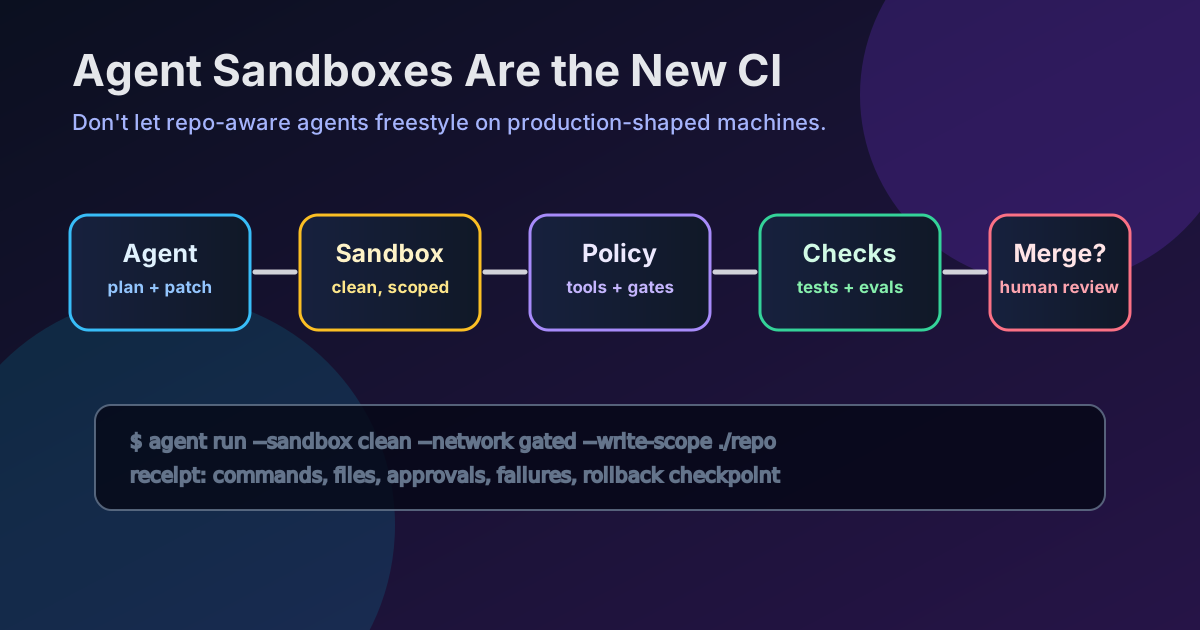
The agent should be able to work in a clean workspace, produce a patch, run checks, emit receipts, and hand the result to a review gate. If it needs more authority, it should request it explicitly.
Not because the model is evil.
Because side effects are real.
“But the agent needs context” is not an excuse
Yes, the agent needs context.
No, that does not mean it needs your entire machine.
Context and authority are different things. This keeps biting people because model UX blurs the line. The agent can read a repo, inspect docs, pull logs, and use tools without also getting unlimited write access, ambient credentials, and arbitrary network reach.
The better pattern is scoped context:
- repo snapshot instead of full home directory
- selected docs instead of every private note
- test fixtures instead of production data
- short-lived credentials instead of ambient secrets
- branch-local changes instead of direct edits to important branches
- explicit tool grants instead of “whatever the shell can do”
That gives the model signal without handing it the keys to the damn building.
Receipts beat trust
Agent work should produce evidence by default.
Not a poetic summary. Evidence.
A useful receipt says:
- which commit or snapshot it started from
- what instructions it followed
- what files it read or changed
- what commands ran
- which tools were called
- what failed
- what was retried
- which approvals were requested
- what tests passed or failed
- what still needs human judgment
This is where sandboxes become more than safety theater. If the agent operates inside a controlled environment, the system can record what actually happened instead of trusting the model to remember its own adventure accurately.
That matters when a patch breaks production, leaks data, or quietly deletes the one fixture the whole test suite needed.

The minimum serious setup
If you are building or adopting agentic devtools in 2026, the minimum serious setup looks like this:
- Disposable workspace — every run starts clean or from a known snapshot.
- Scoped filesystem — the agent sees and writes only what the task requires.
- Network policy — external calls are blocked, logged, or explicitly granted.
- Secret hygiene — no ambient production secrets. Use short-lived, purpose-scoped credentials when needed.
- Tool allowlists — routine commands are allowed; risky operations ask.
- Checkpointing — big edits happen behind reversible snapshots.
- Automated checks — tests, linters, type checks, and project-specific evals run before review.
- Human gate — merge, deploy, customer messaging, billing actions, and destructive operations require approval.
- Receipts — every run leaves logs that are useful after the agent has forgotten everything.
That is not anti-autonomy. That is how autonomy survives contact with real systems.
The agent should not inherit your chaos
The lazy future is agents bolted onto local shells with a warning banner and a prayer.
The better future is agents running in clean, reviewable, permissioned workspaces where success can graduate into more authority and failure stays contained.
That is how you let agents do real work without turning every task into a trust fall.
Agent sandboxes are not the boring plumbing around the product.
They are the product boundary.
And if your coding agent cannot operate inside a clean, logged, scoped environment, it is not ready for more autonomy.
It is ready for a smaller cage.