
AI agents are getting promoted from “cute assistant in the corner” to “thing that can touch repos, browsers, terminals, cloud consoles, tickets, docs, and deployment workflows.”
That promotion changes the secret-management story.
A normal app leaking a token is bad. An agent leaking a token is worse because the leak path is not just code. It is prompts, memory, tool traces, browser state, logs, chat transcripts, MCP configs, shell history, pasted context, generated PR descriptions, and whatever random helper command the agent decided looked reasonable at 2 a.m.
So no, your agent setup does not need more .env files.
It needs blast doors.
Source freshness check: this post was checked on 2026-07-09 against live GitHub API results for agent secret scanning, MCP security, credential vaulting, and runtime guardrails updated during 2026-07-08 to 2026-07-09. Current examples included twylatrumpetlike730/pi-psst, described as injecting vault secrets into bash commands and scrubbing sensitive data from AI agent outputs, updated 2026-07-09; escoffier-labs/content-guard, described as a secret and PII leak scanner for docs, PR bodies, blog drafts, and AI agent output, updated 2026-07-08; PrismorSec/prismor, described as runtime security for agents that blocks dangerous commands and secret leaks, updated 2026-07-08; agentgraph-co/mcp-security-scan, described as an MCP server scanner for hardcoded secrets and unsafe exec, updated 2026-07-08; and tech4242/aquaman, described as an independent credential proxy for AI agents with bring-your-own-vault isolation and least-privilege request policies, updated 2026-07-08. The repo names will churn. The pattern is current as hell: agent stacks are building secret brokers, scanners, and leak guards because ambient credentials are a foot-gun with a rocket strapped to it.
Ambient secrets are agent bait
Developers love convenience. Agents love context. Secrets love accidentally appearing in both.
That is the nasty triangle.
If a token is available in the terminal, an agent may discover it. If a config file contains a key, an agent may summarize it. If a browser session is logged in, an agent may use it. If a tool returns raw credentials, the model may echo them into a trace. If a CI log prints a masked-but-not-really value, the agent may helpfully paste the “important output” into Slack.

The problem is not that agents are malicious. The problem is that agents are obedient pattern machines operating near authority.
If the environment hands them a god key, you built the incident.
Vault access is not enough
“Put secrets in a vault” is necessary.
It is not sufficient.
A vault is storage. An agent secret system needs policy at the moment of use:
- which tool is asking?
- what exact action is being attempted?
- what resource is in scope?
- how long should the credential live?
- can the raw value be shown to the model?
- can the value be written to disk?
- can the value cross a network boundary?
- who approved this access?
- how do we revoke it when the agent gets weird?
The correct default is not “agent can read secret.”
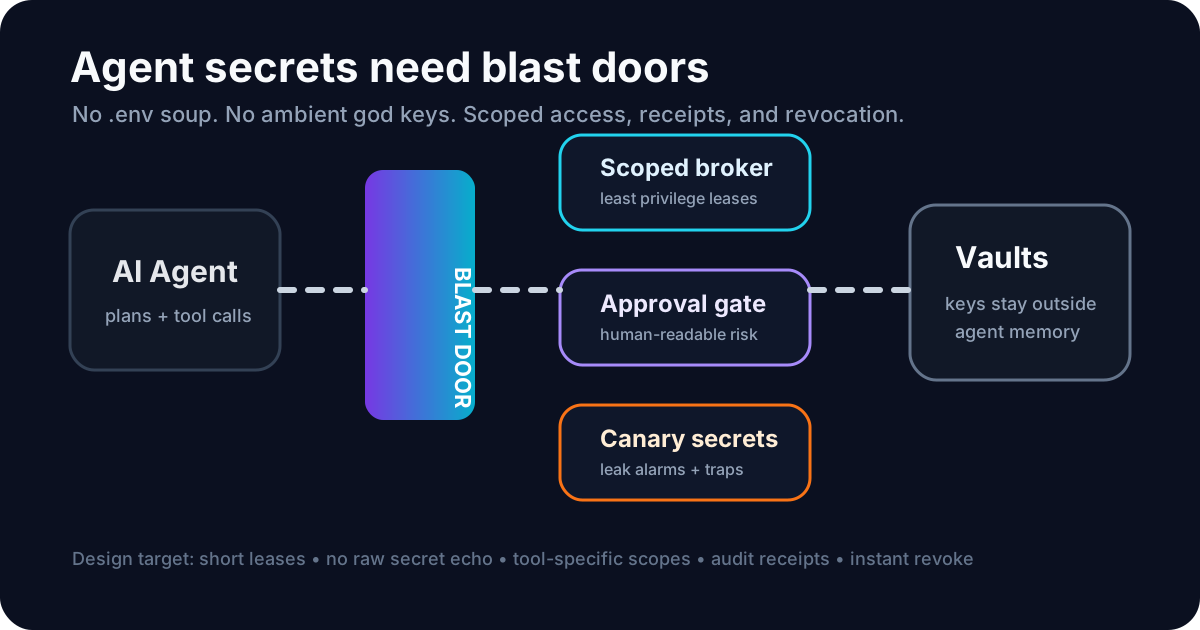
The correct default is “agent can request a narrow capability through a broker, and the broker performs or leases only the minimum needed.”
A deploy tool might get a five-minute token scoped to one environment. A docs crawler gets no production credentials. A browser agent gets session access through a controlled profile, not the human’s entire cookie jar. A shell command gets secret injection at execution time, then output scrubbing before the model sees it.
That is the blast door.
Never put raw secrets in model context
Models do not need raw secrets. Tools need capabilities.
That distinction matters.
If the agent needs to call an API, let the tool call the API. If the agent needs to deploy, let the deployment broker execute the deployment. If the agent needs to open a database migration, give it a scoped migration workflow, not the database password sitting in context like a loaded weapon.
Raw secret exposure should be treated like a production incident, because it usually is.
Good agent-secret design looks like this:
- secret values are never returned to the model by default
- tools receive secret material out-of-band
- tool outputs are scrubbed before they enter chat or traces
- logs store secret fingerprints, not secret values
- approvals describe capabilities, not passwords
- secrets expire quickly
- upgrade or tool changes cannot silently expand access
- every secret use creates a receipt
Receipts are not bureaucracy. Receipts are how you debug the blast radius after something catches fire.

Canary secrets should be everywhere
If agents are going to inspect repos, configs, docs, prompts, logs, and MCP servers, you need leak detection that assumes mistakes will happen.
Plant canary secrets.
Put fake-but-valid-looking credentials in places an agent should never exfiltrate. Give each canary a unique fingerprint. If it appears in model output, a tool trace, a PR body, a chat message, a browser request, or an external paste, sound the damn alarm.
Canaries are useful because they turn “maybe this system leaks secrets” into “this exact path leaked this exact class of secret at this exact time.”
That is actionable.
It also changes behavior. Teams write better prompts, tighter tools, safer traces, and stricter egress rules when the system can catch them being sloppy.
MCP configs need secret linting
MCP makes tools easier to connect.
That also makes secrets easier to scatter.
A local MCP config can quietly accumulate API keys, bearer tokens, command-line args, auth headers, local paths, and privileged server definitions. Then someone copies it into a gist, drops it into a support thread, shares it with an agent, or lets a coding assistant “clean up the config” without noticing what is inside.
MCP servers and configs need first-class secret linting:
- hardcoded keys
- unsafe environment passthrough
- broad filesystem roots
- shell commands with inline credentials
- headers that should be vault references
- servers asking for more scope than their job requires
- prompt instructions that encourage credential disclosure
- tool responses that echo sensitive values
This should run before install, before commit, before CI, before support upload, and before an agent gets to summarize the file.
Not after the breach report.
Build the broker, not the bunker
The goal is not to make agents useless.
The goal is to make power survivable.
Agents should be able to deploy, triage incidents, read dashboards, open PRs, rotate credentials, and run workflows. But that power should pass through narrow, observable, revocable doors.
A sane agent-secret stack has five pieces:
- Vault-backed storage so secrets are not copied around like snacks.
- Capability brokers so tools get scoped actions instead of raw keys.
- Short leases so access naturally dies.
- Output scrubbing and canaries so leaks are caught fast.
- Audit receipts so humans can reconstruct what happened.
That is not overengineering. That is the minimum price of letting semi-autonomous software operate near valuable systems.
The agent era does not make secret hygiene obsolete.
It makes sloppy secret hygiene louder, faster, and more expensive.
Put blast doors in now, or enjoy discovering your production token in a helpful little “summary of changes” message later.