
The least cinematic agent failure is also one of the most expensive: the bot just keeps going.
Not maliciously. Not dramatically. No red lasers. No sci-fi bullshit.
It retries. It searches again. It calls another tool. It expands context. It asks a stronger model. It fans out subagents. It reruns tests. It summarizes the thing it just summarized because the prompt said “be thorough.”
Then somebody opens the dashboard and discovers a $4 task cosplaying as infrastructure spend.
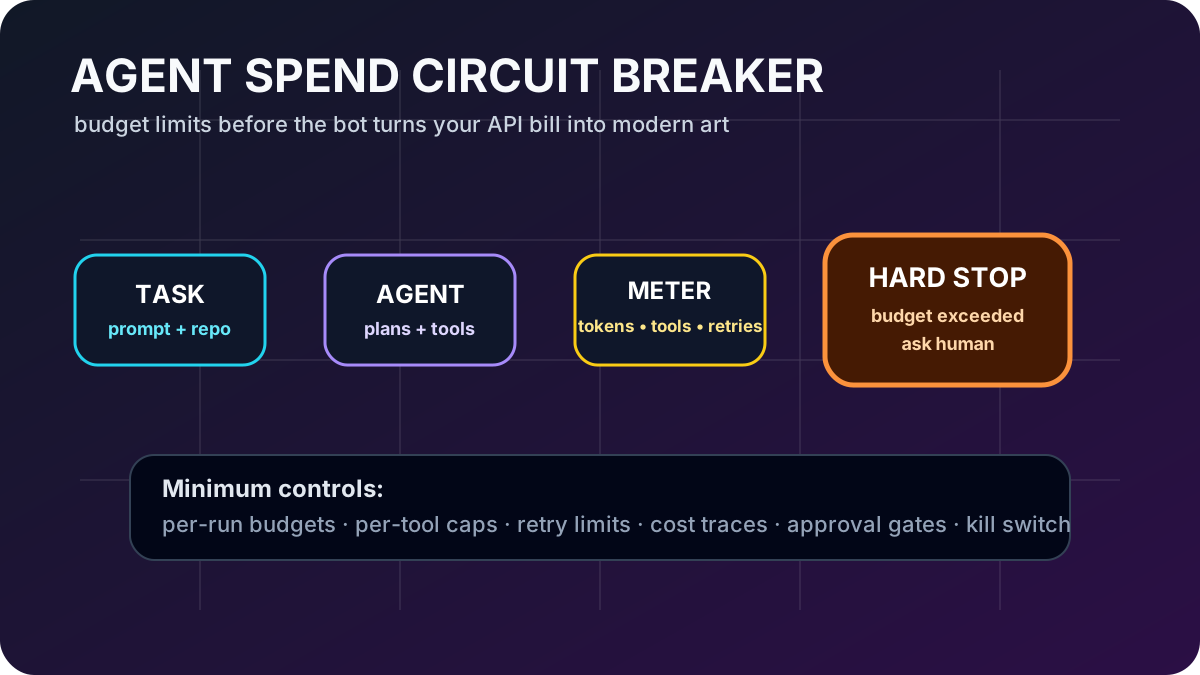
Agent teams need to stop treating cost as an accounting afterthought. Cost is runtime safety. If an agent can act, it needs a budget, a meter, and a circuit breaker.
Source freshness check: this post was checked on 2026-06-21. The current OpenAI Agents SDK usage docs document token/request usage tracking for agent runs and hooks. Fresh repository activity shows the surrounding stack is moving right now: LiteLLM, which describes cost tracking, guardrails, load balancing, and logging, was pushed on 2026-06-21; OpenAI Agents SDK on 2026-06-19; LangSmith SDK on 2026-06-20; Arize Phoenix on 2026-06-20; and OpenTelemetry GenAI semantic conventions on 2026-06-20. The point is current: agent stacks are adding usage, tracing, and observability plumbing because autonomous workflows need operational controls, not just clever prompts.
“Just monitor the bill” is coward architecture
Looking at aggregate spend after the fact is not control.
That is a receipt.
A receipt is useful when you already screwed up. It helps finance yell at the right dashboard. It does not stop the agent from burning through a budget while everyone is asleep.
Real control happens inside the run:
- how many model calls are allowed?
- how many tokens can this task consume?
- which tools have per-run limits?
- how many retries before the agent must stop?
- when does it downgrade model choice?
- when does it ask a human?
- when does the kill switch fire automatically?
If your answer is “we trust the agent to be reasonable,” congratulations, you built a slot machine with a GitHub token.

Agents make spend nonlinear
Normal app cost is boring in a good way.
A user clicks a button. Your backend does a known amount of work. Maybe it calls one model. Maybe it writes one record. You can estimate it, cache it, rate-limit it, and sleep like a person with boundaries.
Agents are different.
An agent can decide that the next step requires more context, another search, a browser session, a code interpreter run, a vector lookup, a second model, a third model, a test command, a retry, and a “reflection” pass because some framework author named it something soothing.
That does not make agents bad.
It means the cost curve is no longer a straight line from request to response. It is a branching workflow with model calls as fuel.
So the budget cannot live only in finance. It has to live in the execution engine.
Token budgets are not enough
Token limits are the obvious first move, and yes, you need them.
But token budgets alone miss the expensive parts of real agent work:
- paid search or enrichment APIs
- browser automation sessions
- code sandbox time
- database reads over large result sets
- vector store queries
- long-running evals
- CI minutes
- external SaaS actions
- subagent fan-out
- human-review queues
A serious budget model tracks units of work, not just tokens.
The agent should know the price of its behavior in the same way a database query planner knows cost. Not perfectly. Not with fake precision. Enough to avoid lighting money on fire.
Minimum viable controls:
- Per-task budget — the total spend ceiling for a delegated job.
- Per-step budget — stop one tool loop from eating the whole run.
- Per-tool budget — expensive tools get tighter caps than cheap reads.
- Retry budget — retries are not free just because the code is polite.
- Model budget — strong models need explicit escalation rules.
- Fan-out budget — subagents multiply cost; make that visible.
- Wall-clock budget — time is still money, damn it.
The agent should degrade before it explodes
The best budget system is not just a hard no.
It gives the agent a graceful path down.
Before a run hits the wall, the runtime can force smarter behavior:
- summarize context instead of rereading everything
- switch from a frontier model to a cheaper model for low-risk steps
- stop browsing and ask for a narrower source
- batch tool calls instead of one-at-a-time wandering
- run targeted tests instead of the whole damn suite
- return a partial result with known gaps
- ask a human whether to continue
That is not “limiting the agent.”
That is making it economically literate.
A senior engineer does not rebuild the world every time a ticket is vague. They scope, estimate, cut, and escalate. Agents need the same muscle.

Budget failures should be first-class outcomes
A budget stop is not an error to hide.
It is an outcome the product should support.
When an agent stops because it hit a cap, the user should get a useful receipt:
- what it accomplished
- what it tried
- where the budget went
- what remains unresolved
- what extra budget would buy
- what cheaper path might work
- whether human approval is needed
That is vastly better than quietly truncating the run, hallucinating completion, or dumping “max tokens exceeded” like a cursed fortune cookie.
Budget exhaustion should feel like a safe checkpoint, not a crash.
Observability without budgets is just archaeology
Tracing matters. Usage counters matter. Cost dashboards matter.
But if they only tell you what happened yesterday, they are archaeology.
Useful agent telemetry needs to feed control loops while the run is alive:
- stop when spend crosses a threshold
- alert when a tool loops unexpectedly
- require approval when model escalation exceeds policy
- pause when retry rate looks stupid
- compare actual cost to estimated cost
- attach spend receipts to the final artifact
This is where agent observability and budget enforcement become the same product surface.
The trace should not just answer “what happened?”
It should help decide “do we let this continue?”
Put budgets in the agent contract
Every production agent should ship with a contract that says what it is allowed to spend.
Example:
agent: repo-maintenance-bot
budget:
  max_usd_per_run: 2.50
  max_model_calls: 40
  max_tool_calls: 80
  max_wall_clock_minutes: 20
  max_subagents: 3
escalation:
  require_human_after_usd: 1.75
  require_human_for_model: frontier
  stop_on_retry_loop: true
receipts:
  include_usage_summary: true
  include_tool_costs: true
  include_budget_stop_reason: true
Not because YAML is holy. It is not. YAML is where whitespace goes to start bar fights.
But explicit contracts beat vibes.
If an agent cannot tell you its budget, it is not ready to act autonomously.
The product angle is trust
Users do not trust agents because the demo is flashy.
They trust agents when the system behaves like it has brakes.
A good agent UI should show:
- estimated cost before starting
- live spend during execution
- remaining budget
- expensive steps before they happen
- human approvals for budget escalation
- final receipt by model, tool, and phase
That turns agent cost from a scary surprise into a managed resource.
It also forces product teams to make real decisions. Which tasks deserve autonomous execution? Which steps need approval? Which customers get higher caps? Which agents are too expensive to be default-on?
Those are product questions, not just infra questions.
Cheap agents will win more work
The winning agent platforms will not just be the smartest.
They will be the ones that can do useful work predictably.
Predictable means:
- bounded cost
- observable work
- clean receipts
- safe stops
- graceful degradation
- escalation instead of runaway loops
That is how agents move from “cool demo” to “I can put this in a production workflow without sweating through my shirt.”
So yes, make the agent smarter.
But also make it cheaper to trust.
Meters. Budgets. Circuit breakers. Receipts.
Ship the brakes before the bot discovers your credit card limit.